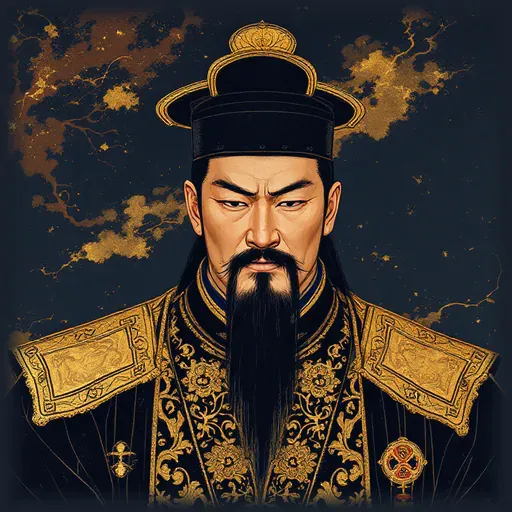
Wei Strategist
Cao Cao, the Hero of Chaos
曹操155 to 2205 star
In short
Cao Cao (155 to 220) was the warlord who reunited northern China as the Han dynasty collapsed. He took the emperor into his keeping in 196, beat the far larger army of Yuan Shao at Guandu in 200, and lost the south at Red Cliffs in 208. He died King of Wei, never emperor. His son Cao Pi ended the Han within the year and founded the state of Wei on what he had built.
| Lived | 155 to 220 |
|---|---|
| Name in Chinese | 曹操 |
| Courtesy name | Mengde |
| Served | the Han court, then himself as Chancellor and King of Wei |
The history
Cao Cao was born in Qiao, the grandson by adoption of a palace eunuch, which gave him money and no standing. The judge of character Xu Shao is said to have called him a capable minister in an ordered age and a treacherous hero in a disordered one. He raised his own troops against Dong Zhuo in 189 and built his army from the surrendered Yellow Turbans of Qing Province.
In 196 he brought Emperor Xian to Xu and from then on gave his orders in the emperor’s name. In 200 Yuan Shao marched south with an army several times his own. Cao Cao held at Guandu for months, burned Yuan Shao’s grain at Wuchao on the word of a defector, and broke him. By 207 the north was his.
The south was not. In 208 his fleet was burned at Red Cliffs by the allied forces of Sun Quan and Liu Bei, and the Yangtze stayed a border for the rest of his life. He became King of Wei in 216 and died at Luoyang in 220.
He settled soldiers and refugees on state farms, which fed his armies when others starved, and he issued orders asking for men of talent whatever their character. His commentary on Sun Tzu survives, and so do his poems.
The novel
Romance of the Three Kingdoms takes Liu Bei’s side, so Cao Cao is its great antagonist: clever, suspicious and cruel. It gives him the line that he would rather wrong the world than have the world wrong him, and the killing of Lu Boshe’s household that goes with it. The story comes from sources hostile to him, and the versions disagree.
Cao Cao in the game
In Warlords of the Three Kingdoms Cao Cao is the Hero of Chaos: a 5 star strategistof Wei. The game's line for him: “Xu Shao called him a capable minister in peace and a treacherous hero in chaos; he laughed and took the second.”
| Kingdom | Wei |
|---|---|
| Role | Strategist |
| Rarity | 5 star |
| Base attack and defense | 51 and 53 |
| Where from | Summoned at the Imperial Summon, for Jade. The odds are shown before every summon. |
A warlord sworn to Wei fields him 10% stronger, as every General of their own Kingdom. Wei, Shu or Wu has what the choice changes.
Qinggang Sword is his signature: holding it raises his attack and defense by 15%. New Book of Mengde is his signature: holding it raises his attack and defense by 15%.
Five star is where he starts. Duplicates become shards, shards add stars, and each star adds a tenth to both numbers.
Questions
Was Cao Cao a villain?
The novel makes him one, and the stage paints his face white for treachery. The history is kinder. Chen Shou calls him an extraordinary man, a commander who promoted on ability and wrote law, commentary and verse. He was also ruthless, and the massacres in Xu Province in 193 are in the same record.
Did Cao Cao become emperor?
No. He held the emperor from 196, became Chancellor in 208 and King of Wei in 216, and died in 220 without taking the throne. His son Cao Pi did, later that year, and named him Emperor Wu of Wei after his death.
How did Cao Cao die?
Of illness at Luoyang in March 220, aged sixty five. The novel has him die of a disease of the head after imprisoning the physician Hua Tuo. The history records only the illness.
How do you get Cao Cao in Warlords of the Three Kingdoms?
Summoned at the Imperial Summon, for Jade. The odds are shown before every summon.
Sources
The history follows Chen Shou's Records of the Three Kingdoms, written in the third century, with Pei Songzhi's annotations of the fifth, and Fan Ye's Book of the Later Han for the years before the Han court fell apart. What the page calls the novel is Luo Guanzhong's Romance of the Three Kingdoms, of the fourteenth century. Where the two disagree, the page says which is speaking. For more on him, see Cao Cao on Wikipedia.
Written by Gitkonek Studio, .
Keep reading
- Sima Yi, the Wolf Who Looks BackHe outwaited Cao Cao, outlasted Zhuge Liang, and left his grandsons an empire that had not been his.
- Zhang Liao, the Terror of HefeiAt Xiaoyao Ford his eight hundred broke Sun Quan's host, and in Wu his name was used to quiet crying children.
- Dian Wei, the Guard at WanchengHe held the camp gate at Wancheng with a halberd in each hand so that his lord could reach the river.
- Guo Jia, the Demon TalentCao Cao's favorite strategist, whose counsel won the north and whose death, Cao Cao said, lost Red Cliffs.
- Xiahou Dun, the One-Eyed GeneralStruck in the eye by an arrow, he pulled it out and ate the eye, saying he would not waste a gift from his parents.