The history
Who won the Three Kingdoms? None of the three
4 minute readBy Gitkonek Studio
In short
None of the three kingdoms won. Wei conquered Shu in 263, but the Sima family, who had run Wei since a coup in 249, took its throne in 266 and founded the Jin dynasty. Jin conquered Wu in 280 and reunified China. The winner was Sima Yan, Emperor Wu of Jin, grandson of the Wei strategist Sima Yi.
The novel opens with the line that the empire, long divided, must unite. It does not say who will do the uniting, and the answer is the least satisfying one available: somebody else.
The short version
| Year | What happened |
|---|---|
| 184 | The Yellow Turban Rebellion. The Han court arms its governors |
| 189 | Dong Zhuo seizes the capital and the emperor |
| 200 | Cao Cao beats Yuan Shao at Guandu and takes the north |
| 208 | Sun Quan and Liu Bei burn Cao Cao’s fleet at Red Cliffs |
| 220 | Cao Cao dies. His son Cao Pi ends the Han and founds Wei |
| 221 | Liu Bei declares himself emperor of Shu Han |
| 229 | Sun Quan declares himself emperor of Wu |
| 234 | Zhuge Liang dies on his fifth campaign north |
| 249 | Sima Yi takes control of Wei in a coup |
| 263 | Wei conquers Shu |
| 266 | Sima Yan deposes the last Wei emperor and founds Jin |
| 280 | Jin conquers Wu. China is one state again |
Why it was always going to be the north
The three were never equal. Wei held the Yellow River plain, where most of the people of China lived, and the old capitals with their officials and records. Shu had one rich province behind mountains. Wu had the Yangtze and a frontier of unsettled hills.
The registers taken when each state fell give the scale. Shu surrendered with about 940,000 people on its books and Wu with about 2.3 million. Wei, at about the same time as Shu’s fall, counted about 4.4 million. The figures undercount everyone, since they miss whoever the tax collector missed, but the proportions are fair.
So Shu and Wu could win battles and could not win the war. Zhuge Liang’s answer was to attack anyway, on the reasoning that a small state that sat still would lose slowly. He marched north five times and died on the fifth. Wu’s answer was the river, and it worked for as long as the north was busy.
How Wei was taken from inside
The north stopped being busy with its neighbours and became busy with itself.
Sima Yi had served Cao Cao, his son and his grandson, and had beaten every enemy they pointed him at. In 239 the second Wei emperor died and left a child on the throne with two regents, Sima Yi and Cao Shuang. Cao Shuang took the power for himself. Sima Yi pleaded age and illness for years, and in 249, while Cao Shuang was outside the capital visiting the imperial tombs, he shut the gates of Luoyang and took the government in a day.
He died two years later. His sons kept what he had taken. Sima Shi deposed one emperor. Sima Zhao’s men killed the next in the street, when the young emperor, Cao Mao, led his own guards out against him with the words that Sima Zhao’s intentions were known to every passer by.
The three endings
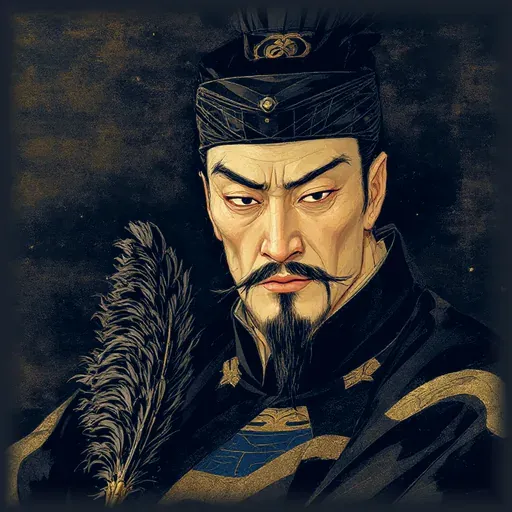
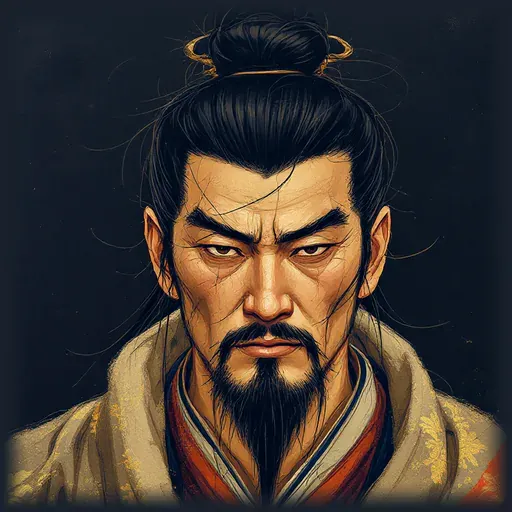
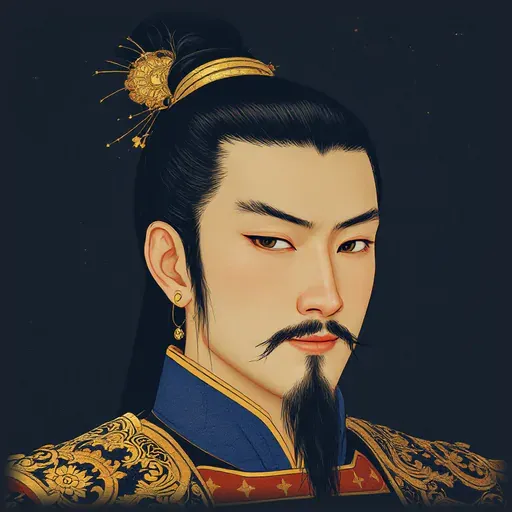
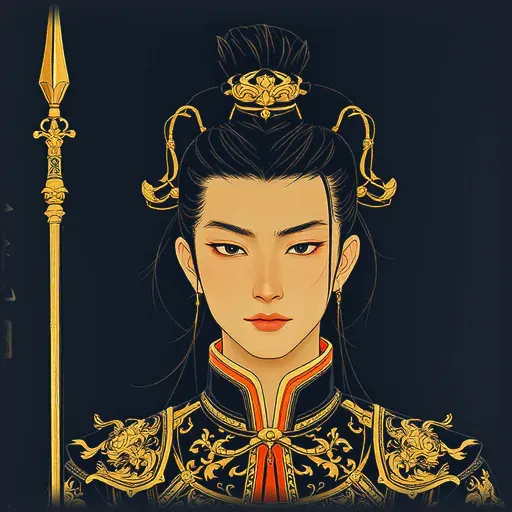
Shu, 263. Sima Zhao sent two armies. Zhong Hui pinned Jiang Wei at Sword Pass. Deng Ai took his men seven hundred li through uninhabited mountains by the Yinping path, wrapped himself in felt to roll down the last slopes, and appeared on the plain behind every defense. Liu Shan surrendered Chengdu. Within months Zhong Hui and Jiang Wei tried to raise Shu in revolt and were killed by their own troops, and Deng Ai was murdered in the confusion.
Wei, 266. Sima Zhao died in 265. His son Sima Yan had the last Wei emperor, Cao Huan, abdicate early in 266, the same thing the Cao family had done to the Han forty five years before. The new dynasty was called Jin.
Wu, 280. Sun Quan’s grandson Sun Hao ruled badly and long. Jin built a fleet on the upper Yangtze and came down the river and across it in six columns. Sun Hao surrendered at Jianye in the spring. The campaign had taken under half a year.
So who won
Sima Yan, who did none of the fighting that people remember. Not one of the men the story is about lived to see it. Cao Cao, Liu Bei, Sun Quan, Zhuge Liang, Guan Yu and Zhou Yu were all dead before the first kingdom fell.
That is why the period is remembered the way it is. The ending belongs to people who came late and inherited. The story belongs to the ones who lost.
The peace did not last, either. Jin’s princes were at war with one another by 291, and the north was lost to invasion in 316.
In the game
Warlords of the Three Kingdoms follows the same chronicle in eight chapters, from the Yellow Turban Rebellion to the last, Fall of the Kingdoms, and the men of the ending are in its roster: Sima Yi, Deng Ai, Zhong Hui and Jiang Wei. Its war between Wei, Shu and Wu has no Jin. It is fought by the players and settled every Sunday, and whichever Kingdom wins has to do it again the next week.
Sources
The events are from Chen Shou’s Records of the Three Kingdoms and its annotations, and the Book of Jin for the conquest of Wu. The population figures are the registers quoted in those annotations and in later histories, as collected in the article on the Three Kingdoms.
Questions
Who won the Three Kingdoms war?
The Jin dynasty, which was none of the three. The Sima family took over Wei from inside, replaced it with Jin in 266, and conquered Wu in 280.
Which of the Three Kingdoms was the strongest?
Wei. It held the north, the old capitals and most of the people. Its registers near the end counted about 4.4 million people, against about 2.3 million in Wu and under a million in Shu.
Which kingdom fell first?
Shu, in 263, when the Wei general Deng Ai crossed the mountains by an unguarded path and Liu Shan surrendered Chengdu. Wei itself ended in 266 and Wu in 280.
How long did the Three Kingdoms period last?
Sixty years by the strict count, from the end of the Han in 220 to the fall of Wu in 280. Most tellings start earlier, with the Yellow Turban Rebellion of 184, which makes it ninety six.
What happened to the last rulers of Wei, Shu and Wu?
All three lived. Liu Shan of Shu was made Duke of Anle and Sun Hao of Wu Marquis of Guiming, both in the Jin capital. Cao Huan of Wei became Prince of Chenliu and died in 302.
Keep reading
- The Five Tiger Generals of Shu: who they wereGuan Yu, Zhang Fei, Zhao Yun, Ma Chao and Huang Zhong. Who the Five Tiger Generals were, what each did, and why the title is the novel's.
- Who was Lu Bu, and why is he always the strongestLu Bu was a real cavalry officer who killed two adoptive fathers and lost anyway. Here is the history, and why games keep making him unbeatable.
- Games like Mafia Wars in 2026, and one set in the Three KingdomsMafia Wars closed years ago, but its loop of energy, jobs, properties and fights lives on. Here is where to find it now, including in 200 AD.